
The promise of artificial intelligence in project management has moved well beyond speculation. We now have hard data showing exactly how AI transforms project outcomes. It also includes real-world case studies demonstrating dramatic improvements, and clear use cases proving that AI isn’t just nice to have, it’s becoming essential for competitive project delivery.
If you’re exploring project management as a career or looking to understand where the profession is heading, the evidence is compelling. AI adoption isn’t just about efficiency gains. It’s about fundamentally changing what’s possible in terms of project success rates, resource utilization, and strategic decision-making.
The Numbers Tell a Powerful Story
KPMG’s research into companies using AI in their project workflows reveals an average productivity boost of 15%. But productivity is abstract. What does that actually mean for project outcomes?
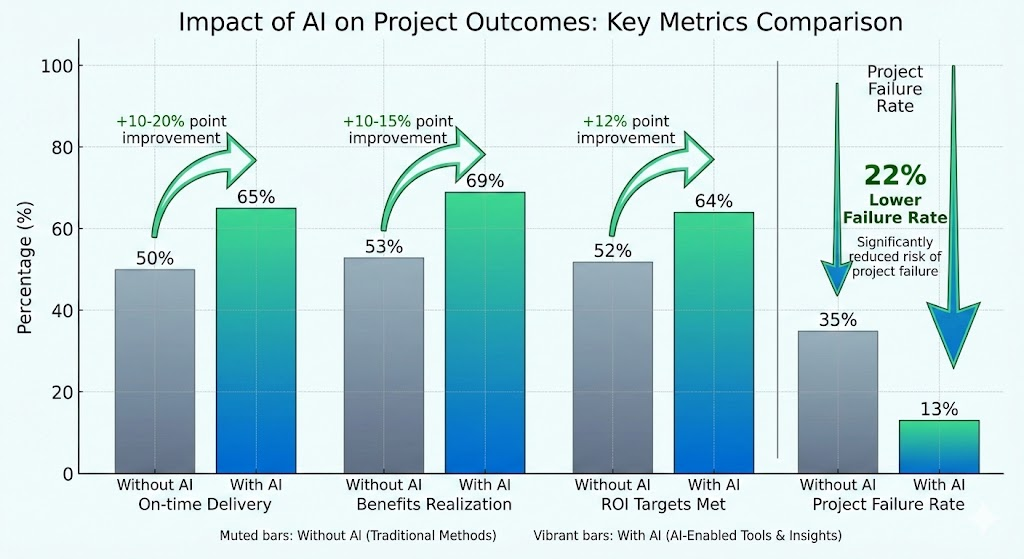
The data gets more specific – on-time delivery rates improve by 10-20 % points compared to organizations not using AI. This improvement comes primarily from automated forecasting that can predict delays and bottlenecks before they cascade into major problems.
Benefits realization: the % of projects that actually deliver the value they promised jumps by 10-15% points. For example, an organization might go from 53% of projects meeting 95% of their targets to 69% hitting that mark. This improvement stems from real-time risk scoring that helps teams course-correct while there’s still time to salvage outcomes rather than discovering problems during post-mortem reviews.
Return on investment consistency shows similar gains, improving from 52% to 64% of projects meeting ROI targets. The driver here is predictive cost modeling that spots budget overruns forming weeks before they show up in traditional financial reports. Looking forward, Gartner predicts that 75% of enterprises will be using AI for project portfolio management by 2027. Current leaders in AI adoption are already seeing 22% lower project failure rates compared to organizations lagging behind a gap that’s likely to widen as AI capabilities mature and compound over time.
Real-world validation: Acciona, a leader in sustainable infrastructure, has demonstrated exactly this kind of financial predictability in practice. By deploying AI systems that continuously forecast expenses and flag emerging cost overruns before they materialize in traditional reports, they achieved a 15% reduction in budget variances across their construction portfolio. The technology doesn’t just report what’s happening. It anticipates what’s about to happen, giving project teams the lead time needed to course-correct before small deviations compound into major financial problems.
Looking forward, Gartner predicts that 75% of enterprises will be using AI for project portfolio management by 2027. Current leaders in AI adoption are already seeing 22% lower project failure rates compared to organizations lagging behind a gap that’s likely to widen as AI capabilities mature and compound over time.
A Real Transformation: Three Years of Data
Statistics from research firms are valuable, but nothing demonstrates AI’s impact quite like following a single organization through its adoption journey. Let’s examine a 150-person engineering firm that implemented AI resource management starting in 2023, tracking their progress through three complete years.
The Starting Point
Before implementing AI, this firm was struggling with challenges familiar to many project-driven organizations. They were running 25 concurrent projects with a 22-person project team. Their on-time delivery rate sat at just 18% meaning more than 8 out of 10 projects missed their deadlines. Lead times stretched between 12 and 18 months for typical projects. They were delivering 25 projects annually, but the inefficiency was obvious to everyone involved.
Year One: The Foundation
After implementing AI resource management tools, the first year brought dramatic improvements. On-time delivery jumped to 48%, still not great by absolute standards. But a 167% improvement from baseline. Lead times compressed to 6-9 months, cutting typical project duration nearly in half. Most strikingly, their output surged to 48 projects delivered, a 92% increase despite no significant change in team size.
The AI wasn’t making people work faster or longer hours. It was eliminating the constant resource conflicts and bottlenecks that had been causing projects to stall while waiting for the right people to become available.
Year Two: Compounding Returns
The second year showed that the gains weren’t a one-time adjustment but rather a compounding improvement as the AI system. It was learned from more data and the team became more proficient at using insights. On-time delivery climbed to 76%. Lead times dropped further to 4-6 months. Project output reached 76 completed projects, a 58% year-over-year increase on top of the first year’s gains.
Year Three: Operating at a New Level
By the third year, the firm had essentially transformed into a different organization in terms of capability. On-time delivery hit 80%, meaning 4 out of 5 projects now finished on schedule compared to fewer than 2 out of 10 three years earlier. Lead times compressed to just 3-4 months a quarter of the original duration. They delivered 98 projects despite the team actually shrinking to 17 people as some experienced staff retired or moved on.
Think about what this means: over three years, they achieved a 200% increase in total delivery capacity while actually reducing headcount by 23%. This wasn’t about working people harder in fact, unplanned overtime dropped by 42% over the same period.
The broader efficiency metrics tell the same story. Resource utilization improved by 21%, meaning people spent more time on productive project work rather than waiting for dependencies or dealing with scheduling conflicts. Idle time dropped by 35%, and that 42% reduction in unplanned overtime suggests people were actually experiencing better work-life balance despite the dramatic increase in output.
How AI Actually Works in Practice?
Understanding that AI improves outcomes is one thing. Understanding the specific mechanisms through which it creates value is what matters if you’re building PM skills for this new environment. Let’s break down the key use cases with enough detail to see exactly what’s happening.
Capacity Forecasting: From Guesswork to Precision
Traditional capacity planning typically involves a PM looking at a spreadsheet of team members, and trying to mentally calculate whether they can take on new work. It’s largely guesswork informed by experience, and it breaks down quickly as complexity increases.
AI capacity forecasting analyzes six months or more of historical data across multiple dimensions: individual skills and certifications, work velocity on different types of tasks, vacation schedules, patterns of sick time, even performance variations across the calendar year. It then predicts where capacity gaps will emerge with enough lead time to do something about them.
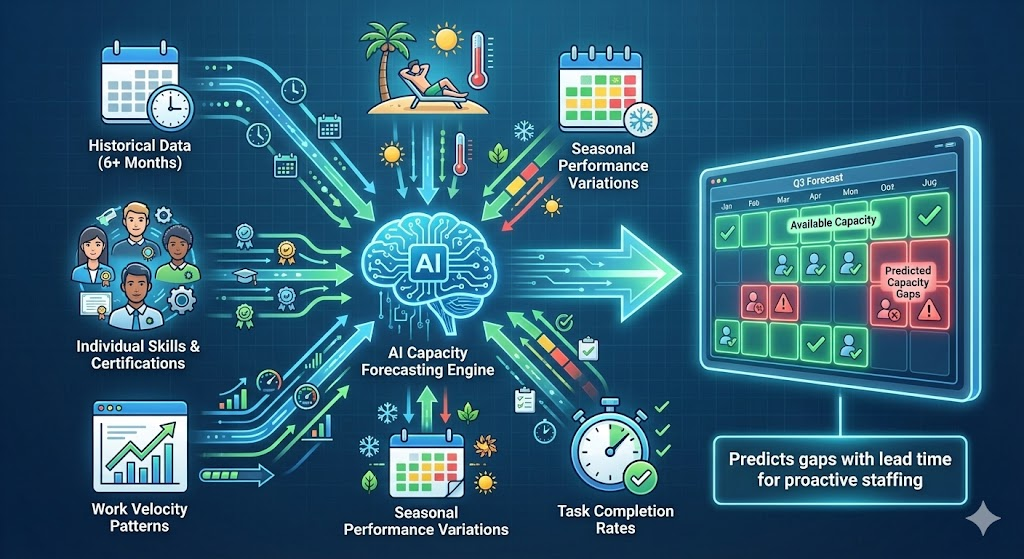
The engineering firm case study provides a concrete result: they went from staffing 35% of projects optimally to 80%. This improvement was the direct cause of their on-time delivery jumping from 18% to 80%. When the right people with the right skills are available when you need them, projects don’t stall waiting for resources to free up from other commitments.
Industry-scale validation: Bechtel, one of the world’s largest engineering and construction firms, has operationalized this exact approach across their massive project portfolio. Their AI systems analyze workforce capabilities and project demands continuously, then generate optimized allocation recommendations that match specialized skills to the specific requirements of each concurrent project. The result has been a 10% reduction in labor costs, not through workforce reductions, but through eliminating the inefficiencies that occur when highly skilled workers are misallocated to tasks that don’t fully utilize their capabilities. More importantly, this optimal matching has driven measurable improvements in both project velocity and quality outcomes.
Portfolio Simulation: Testing Decisions Before Making Them
One of the most powerful applications of AI in project management is running “what-if” scenarios at a scale impossible for humans. A sophisticated AI system can simulate 100 or more different portfolio configurations every night. Scenarios like “what happens if we delay Project A by two weeks and shift three developers to Project B?” or “what if we accelerate Project C but accept a two-week slip on Projects D and E?”
Each simulation calculates the downstream effects across the entire portfolio, identifying constraints, bottlenecks, and resource conflicts. The system then surfaces the top three optimal schedules based on criteria you’ve defined. It can maybe maximize revenue, minimize risk, or balance workload across teams.
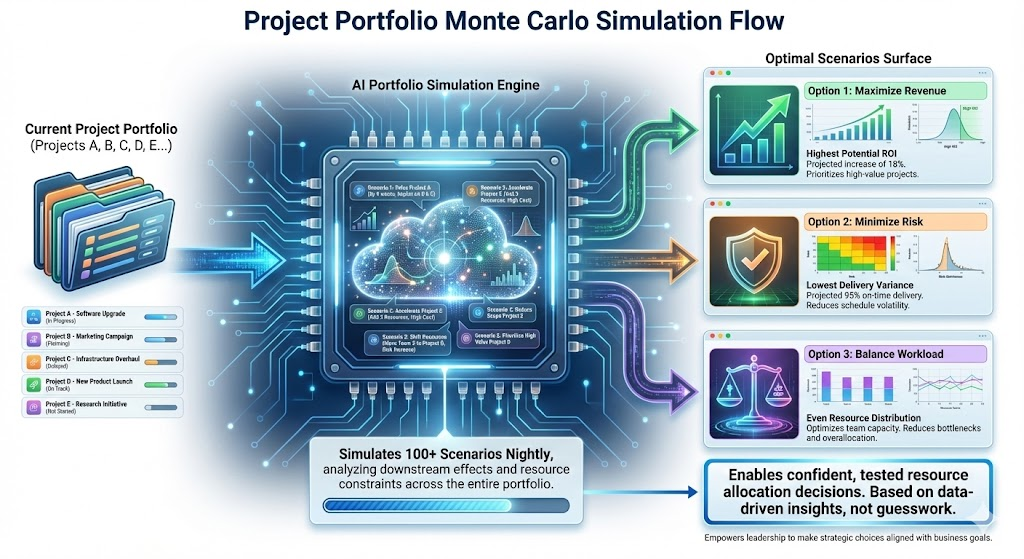
Organizations using portfolio simulation report ROI improvements of around 12 percentage points through bottleneck avoidance alone. The value isn’t just in finding the optimal path, it’s in having the confidence to make bold resource allocation decisions because you’ve already tested them against your constraints.
PM Virtual Assistants: Intelligent Workflow Automation
Tools like Epica represent a category of AI assistance that’s transforming daily PM work. These aren’t just chatbots, they’re systems that understand your entire project context and can answer complex questions with high accuracy.
A PM can ask “What’s my priority today?” and get an answer that considers task dependencies, stakeholder commitments, deadline proximity, and resource availability across their entire portfolio. They can ask “When can I take PTO?” and receive suggestions that account for critical path activities and upcoming milestones. The system achieves about 92% accuracy on these context-dependent queries by continuously learning from how projects actually unfold versus how they’re planned.
Practical implementation: Fluor Corporation has implemented AI systems that analyze historical project patterns, upcoming pipeline commitments, and seasonal demand fluctuations to forecast labor requirements across different skill categories weeks or months in advance. The technology then generates optimized schedules that match available talent to predicted needs while considering factors like skill development opportunities and work-life balance preferences.
Perhaps more valuable is the system’s ability to auto-manage low-priority administrative tasks sending reminders, updating status fields, chasing down information without PM intervention. PMs report freeing up approximately 10 hours per week. This is how they redirect toward high-value activities like stakeholder alignment and strategic problem-solving that AI can’t yet handle effectively.
Risk Prediction: Early Warning Systems
Traditional risk management is largely reactive. You identify risks during planning, assign probability and impact scores, and check in periodically. But by the time a risk becomes obvious enough to discuss in a status meeting, it’s often too late for anything other than damage control.
AI risk prediction works differently. It continuously monitors task velocity, comparing actual progress against historical patterns for similar work. It correlates these velocity patterns with external factors: vendor delivery patterns, dependency chains. It flags the emerging issue 10-14 days before it would become visible through traditional tracking.
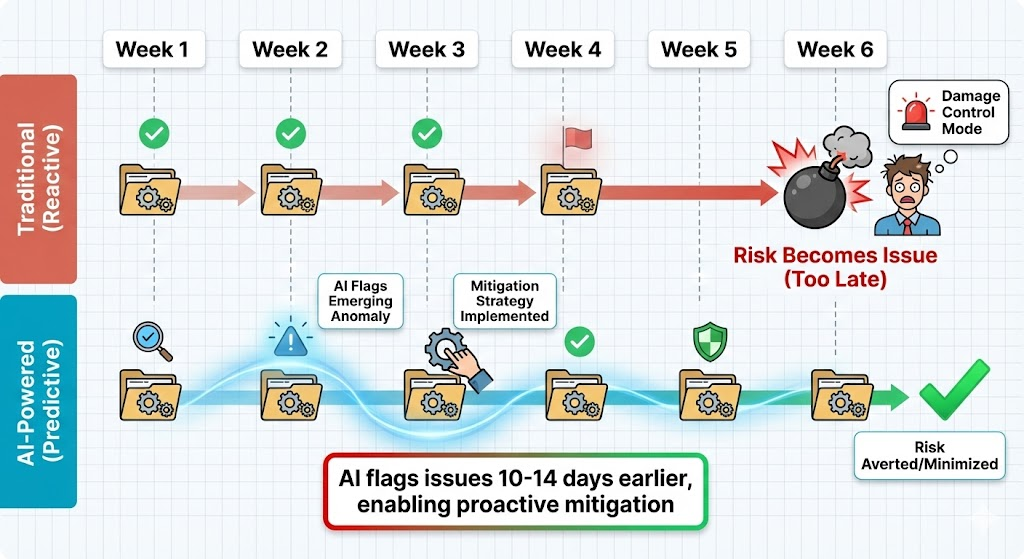
Organizations using AI risk prediction report a 28% reduction in variance across multi-project portfolios. This means more predictable delivery, fewer surprise delays, and more time to implement mitigation strategies before risks materialize into issues.
What Does This Means for Your Project Management Journey?
If you’re developing project management skills right now, you’re facing both a challenge and an opportunity. The challenge is that the profession is evolving faster than educational programs and traditional certifications can keep pace. The opportunity is that you can build AI-native PM capabilities from the beginning rather than having to unlearn old habits.
Understand the Fundamentals First
AI tools are powerful amplifiers, but they amplify both competence and incompetence. If you don’t understand basic project management principles scope management, stakeholder communication, risk identification, team dynamics. AI won’t magically make you effective. It will just help you fail faster and more efficiently.
Build your foundation in core PM competencies first. Learn how to build a work breakdown structure, develop a realistic schedule, identify and manage stakeholders, and facilitate effective meetings.
Stay Current with Evolving Tools
The AI PM toolkit is evolving rapidly. Tools that didn’t exist two years ago are now becoming standard. Capabilities that seemed futuristic in 2023 are everyday features in 2025. This isn’t a field where you can learn a toolkit once and use it for a decade.
Make continuous learning part of your professional identity. Experiment with new tools on personal or low-stakes projects. Follow thought leaders who are working at the intersection of AI and project management. Join communities where practitioners share lessons learned from adoption efforts.
The Future Is Already Here
Gartner’s prediction that 75% of enterprises will use AI for project portfolio management by 2027 isn’t really a forecast about the future. It’s a description of what’s already unfolding. The organizations achieving 22% lower failure rates aren’t lucky; they’re simply ahead of the adoption curve.
The question for anyone building a PM career isn’t whether AI will transform the profession, it already has. The question is whether you’ll develop the skills to thrive in this transformation or spend your career playing catch-up with more adaptable peers.
The evidence is clear: AI makes good project managers better by eliminating administrative burden and providing insights impossible to generate manually. It doesn’t replace the need for human judgment, emotional intelligence, and strategic thinking. It amplifies these uniquely human capabilities by freeing PMs to focus on them.
Master AI-Powered Project Management in Just 2 Days
Reading about these transformations is valuable. Actually developing the skills to achieve similar results in your own projects is what creates career differentiation.
That’s why we’ve created our 2-Day Intensive: AI-Powered Project Management Workshop designed specifically for professionals who want to build competitive advantage in a rapidly evolving field.
Day 1: Foundations and Tools You’ll gain hands-on experience with the core AI capabilities transforming PM work.
Day 2: Real-World Application You’ll work through actual project scenarios drawn from the case studies you’ve read about:
This isn’t theory, it’s practical skill development with the exact tools described in this article. You’ll leave with capabilities that most PMs won’t develop for another 2-3 years, giving you a significant competitive advantage in a profession where AI literacy is rapidly becoming essential.
The gap between AI leaders and laggards is widening. The engineering firm in our case study didn’t achieve 200% productivity gains by reading about AI. They achieved it by implementing these tools systematically and learning to use them effectively.
Download the detailed curriculum
The transformation in project management is happening now. The only question is: will you lead it, or follow it?
Reference