

If you’re considering a career in project management or you’re already a PM curious about where the field is heading there’s one trend you can’t ignore. Artificial intelligence is fundamentally changing how projects get planned, executed, and delivered.
But here’s what makes this moment particularly interesting: we’re at an inflection point. The technology exists, the benefits are proven, yet most organizations haven’t fully embraced it. This creates a unique opportunity for anyone entering the field to build AI-native project management skills from day one.
The Current State: A Massive Gap Between Promise and Practice
Let’s start with a striking contradiction in the data. When business leaders are surveyed globally. Over 80% say they expect AI to transform how their organizations work. They see the potential. They understand the direction. Yet when we look at actual implementation, only 20-25% of organizations have meaningfully integrated AI into their core project management processes.
Think about what that gap represents. It’s not skepticism about AI’s value, it’s the challenge of organizational change, the friction of adopting new tools, and often simply not knowing where to start. For someone entering project management now, this gap is actually good news. You’re not late to the party, you’re arriving just as the real adoption wave is beginning. And, for someone already an established project manager this is an opportunity to re-discover and fall in love with Project Management all over again.
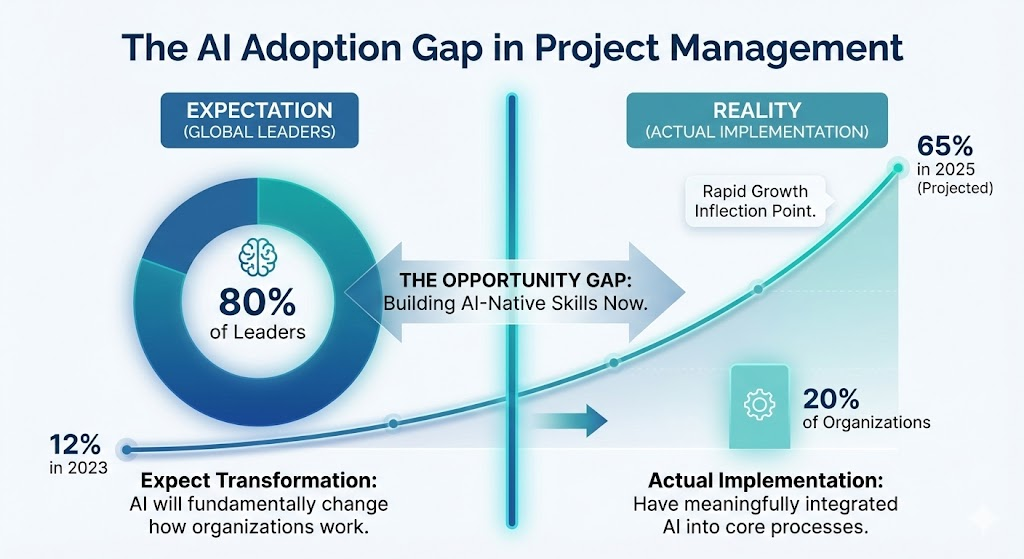
The numbers support this optimism. In 2023, only 12% of enterprises were using AI for project management tasks. By mid-2025, that figure is projected to jump to 65% for at least basic functions like scheduling and reporting. This isn’t incremental growth. It’s an inflection point driven by increasingly accessible tools like Microsoft Project’s Copilot and platforms like ClickUp Brain that are embedding AI directly into familiar workflows.
What Early Adopters Are Learning?
Organizations that have already integrated AI into their project management processes are seeing tangible results. Early adopters report decision-making that’s 30-50% faster when it comes to critical choices about risks and resource allocation. But here’s what’s more interesting than the percentage. It’s why they’re faster.
Traditional project management relies heavily on a PM’s experience and intuition, supported by spreadsheets and manual analysis. There’s nothing wrong with this experience that matters enormously. But AI brings something complementary. The ability to recognize patterns across hundreds or thousands of past projects, spotting correlations and warning signs that even experienced PMs might miss simply because human memory and attention have limits.
This isn’t about replacing PM judgment. It’s about augmenting it with data-driven insights that would be impossible to generate manually.
Four Areas Where AI Is Making Real Impact
Let’s move from abstract benefits to concrete workflows. If you’re learning project management today, here’s what AI-enhanced PM work actually looks like in practice:
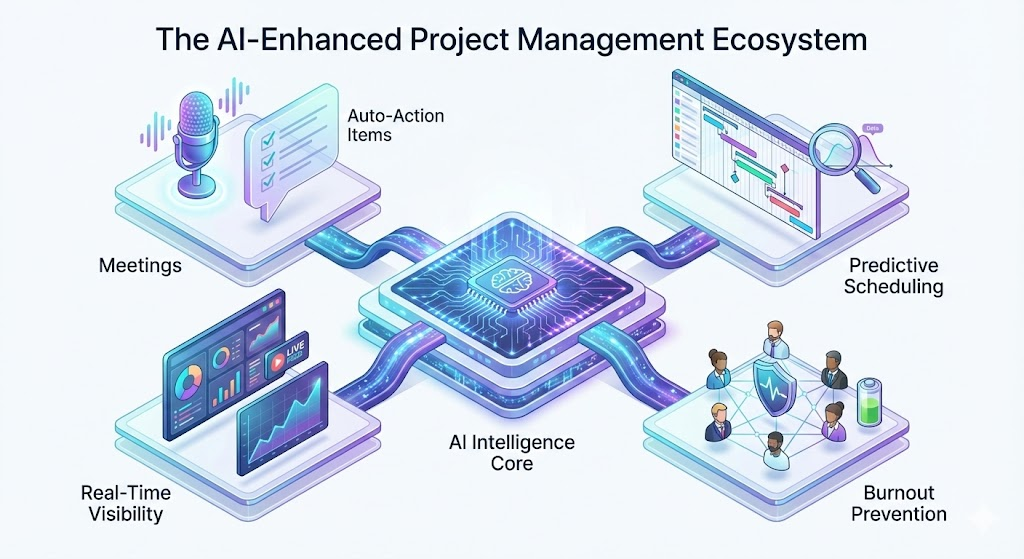
1. Transforming Meetings from Time Sinks into Action Engines
We’ve all been in meetings where half the attendees are frantically taking notes while the other half zone out. Someone needs to spend two hours after the meeting creating a summary and action item list that may or may not capture what actually happened.
AI meeting tools like Otter.ai, when integrated with project management platforms like Jira, are changing this dynamic completely. These systems don’t just transcribe, they understand context well enough to extract 15-20 action items from a typical project meeting. Identify who should own each item based on the conversation, and automatically sync these tasks to the appropriate project boards.
Real-world impact: When Gruve AI implemented Microsoft Copilot across Teams and Planner, the technology began handling meeting transcription and action-item extraction automatically. Copilot now generates comprehensive meeting summaries and distributes follow-up tasks directly within Teams, eliminating the coordination bottleneck that used to consume hours each week. The result has been a dramatic shift in how the team allocates their energy away from administrative coordination and toward creative, strategic work that drives the business forward.
For a 10-person team, this typically cuts manual follow-up work from about two hours per week to roughly 15 minutes of quick review and refinement. More importantly, it means action items don’t fall through the cracks. It is because someone forgot to write them down or because the meeting notes sat in someone’s inbox for three days.
2. Accelerating Project Planning with Intelligent Templates
Here’s a common scenario: a PM needs to create a project timeline for a new mobile app feature. Traditionally, they’d either start from scratch, estimating durations based on gut feel, or they’d dig through past project files to find something similar and adapt it.
Generative AI tools like ChatGPT Enterprise or Notion AI can analyze 50 or more similar past projects in seconds. This suggests task durations that prove accurate about 85% of the time on first pass. The PM still needs to refine these estimates for project-specific risks, team composition, and unique constraints. That critical thinking and contextual knowledge remains irreplaceable. But instead of spending 4-6 hours building a plan from scratch, they might spend 1-2 hours refining an AI-generated draft.
Real-world impact: ClickUp Brain has proven particularly effective in this domain. Project teams using the platform can now auto-generate comprehensive project scope documents and detailed task breakdowns in minutes rather than hours. The AI analyzes historical project data to recommend realistic timelines and dependencies, then continuously monitors progress to surface upcoming milestones and flag potential delays before they become critical. This proactive approach means PMs can make timeline adjustments before small issues cascade into major problems. A capability that’s only possible when AI is constantly pattern-matching against organizational history.
This doesn’t just save time. It also means PMs can produce plans that incorporate organizational knowledge that would otherwise take years to accumulate through trial and error. You dont need to go around looking for someone who eecuted similar projects to have a knowledge transfer. You already have tools to bring the past wisdom. The caveat it that it has been captured in some form earlier.
3. Reporting That Actually Happens (Automatically)
Status reporting is one of those necessary evils of project management. Executives need visibility, but PMs hate spending hours compiling updates when they could be solving actual problems. Meanwhile, reports often become outdated the moment they’re sent.
AI dashboards using tools like Tableau AI or Power BI Copilot are addressing this by pulling data automatically from multiple sources. Jira for task status, Slack for team communication patterns, email for stakeholder sentiment, calendars for meeting load. These systems can generate executive status updates and predict potential delays with about 78% accuracy by analyzing historical velocity data and current patterns.
What used to be a daily or weekly manual process becomes an automated weekly push that PMs review for accuracy and context. More importantly, the predictive capabilities mean risks surface earlier. Instead of discovering you’re two weeks behind schedule when the deadline arrives. You get a flag three weeks in advance when patterns start deviating from historical norms.
4. Preventing Burnout Through Intelligent Resource Management
Resource allocation is one of the hardest aspects of project management. It is because it requires synthesizing information that’s scattered across calendars, skills databases, current project loads, and informal knowledge about who’s struggling or thriving.
AI resource management tools can scan calendars and skills matrices continuously, flagging potential overloads about three weeks before they become critical. They recommend specific shifts, moving tasks between team members, adjusting timelines, or flagging when you need to negotiate for additional resources. It prevents roughly 25% of typical burnout-related delays.
What This Means for Your PM Career?
If you’re considering a career in project management, a new Project manager or a senior vertran Project Leader earlyPM, you might be wondering: does all this AI capability make the role less valuable or necessary? The answer is definitively no, but it does change what valuable PM skills look like.
Here’s how to think about developing your career in this evolving landscape:
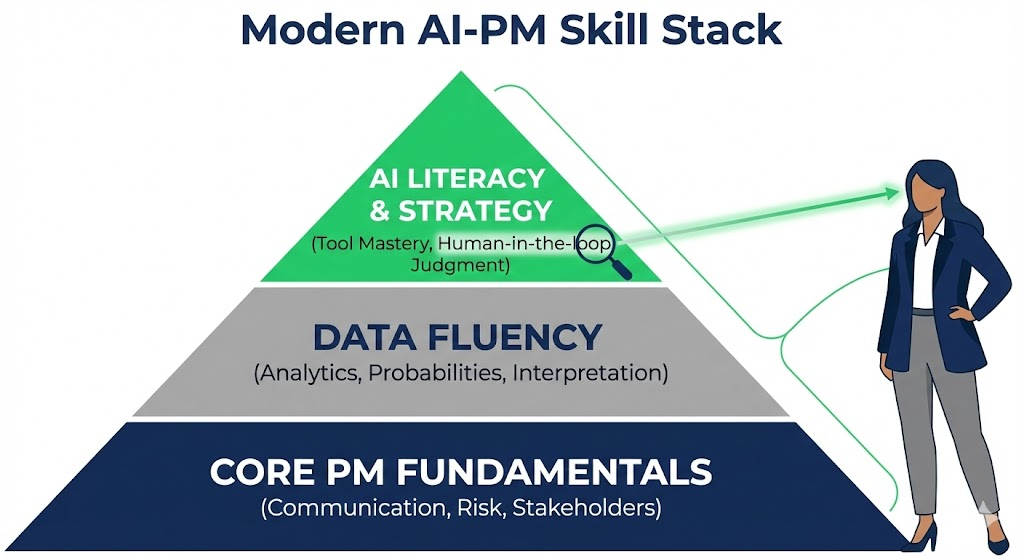
Build strong fundamentals first – AI tools are powerful, but they’re only as good as the person using them. You still need to understand project management principles, stakeholder communication, risk management, and team dynamics. AI enhances these skills, it doesn’t replace the need to develop them.
Become comfortable with data, but don’t lose sight of people. AI brings data-driven insights, which means PMs increasingly need to be comfortable interpreting analytics, understanding probabilities, and making decisions based on quantitative inputs. But the most critical PM skills remain deeply human.
Develop AI literacy specific to PM workflows – You don’t need to become a data scientist, but understanding how AI tools work, what their limitations are, and how to evaluate their outputs is becoming a core PM competency. This means staying current with tools, experimenting with them on small projects. It also develops good instincts for when to trust AI recommendations and when to override them.
Position yourself as a bridge – Organizations need people who can speak both traditional project management language and understand AI capabilities. It is good enough to implement them effectively. If you can help your organization navigate the adoption gap we discussed earlier, you become exceptionally valuable.
The Bottom Line
AI isn’t making project management obsolete, it’s making it more strategic. The administrative burden is decreasing, which means PMs can spend more time on the high-value activities that actually determine project success. This includes building relationships, solving complex problems, navigating ambiguity, and driving meaningful outcomes.
The question isn’t whether AI will transform project management, it already is. The question is whether you’ll be part of that transformation or playing catch-up five years from now. Be the beacon guiding the rest of the organization in bringing the latest and being the best.
Ready to Build AI-Native PM Skills?
Reading about AI in project management is one thing. Actually developing the skills to leverage these tools effectively is another. That’s why we’ve designed a 2-Day Intensive Course: AI-Powered Project Management, specifically for professionals who want to get ahead of the adoption curve rather than scramble to catch up later.
Over two days, you’ll move beyond theory into hands-on practice:
Day 1 focuses on understanding the AI PM landscape and building proficiency with the core tools that are reshaping daily workflows from intelligent meeting management to AI-assisted planning and predictive analytics
Day 2 takes you into real-world application, where you’ll work through actual project scenarios, learn to evaluate AI outputs critically, and develop strategies for implementing these tools in your organization
This isn’t a lecture series. It’s a workshop designed to give you practical experience with the exact tools and workflows described in this article, plus the judgment to know when to trust AI recommendations and when to override them.
Whether you’re launching your PM career or enhancing your existing toolkit, these two days will equip you with skills that most of your peers won’t develop for another 2-3 years, giving you a significant competitive advantage in a rapidly evolving field.
Learn more about the curriculum.
We also help you automate and biring AI to your Project processes. Get in touch with us at Info@proconsultrix.com or …………@navan.ai
The AI transformation in project management is happening now. The only question is: will you lead it, or follow it?
References
https://otter.ai/blog/ai-for-project-management
https://otter.ai/blog/ai-in-consulting
https://clickup.com/blog/how-to-use-ai-project-management/
https://smartdev.com/ai-use-cases-in-project-management/
https://www.tableau.com/products/artificial-intelligence
https://b-eye.com/blog/tableau-ai-use-cases-roi/
https://clickup.com/blog/jira-project-management-template/
https://unito.io/blog/ai-project-management/
https://adoption.microsoft.com/en-us/scenario-library/information-technology/create-a-project-plan/
https://l5.ai/insights/blogs/3-benefits-of-clickup-brain-we-must-know-about